
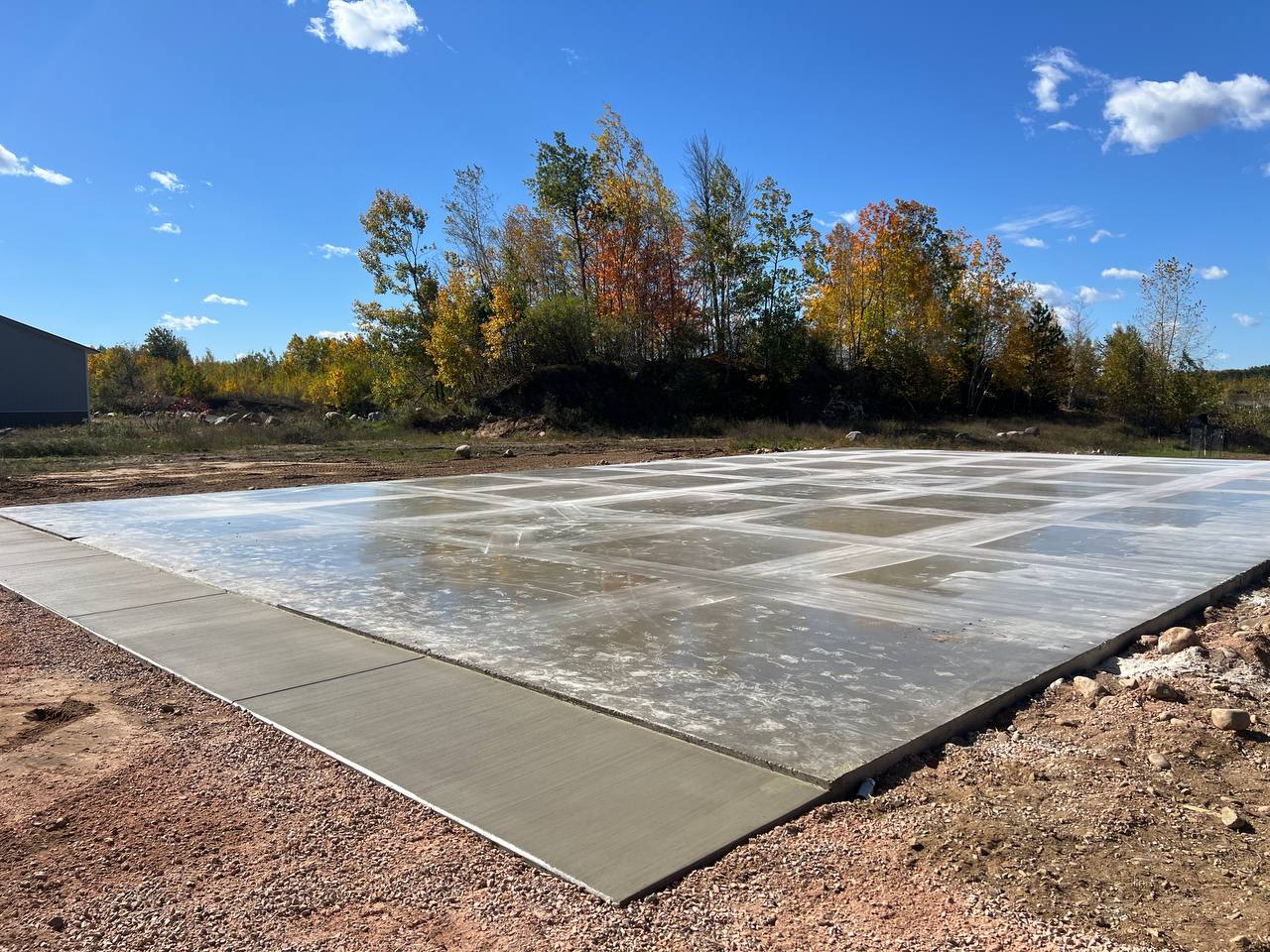
The Fall Concrete Advantage in Northeast Wisconsin
While summer is traditional “construction season,” October actually offers the ideal atmospheric conditions for pouring heavy-duty concrete flatwork across Green Bay, Shawano, and Appleton.
Concrete doesn’t dry, it cures through a chemical process called hydration, where water reacts with cement to form strong crystalline bonds. Controlling the speed and temperature of this reaction determines whether your slab reaches its maximum design strength or cracks prematurely under winter stress.
Why Summer Heat Weakens Concrete
High summer temperatures (85°F+) and direct sunlight disrupt hydration by robbing the mixture of water before chemical bonds fully form:
- Flash Drying & Crust Formations: High temperatures evaporate surface moisture rapidly, causing the top layer to set fast while the core remains wet. This leads to surface dusting, scaling, and micro-cracking.
- Elevated Water Demand: Contractors often add excess water on-site to keep hot concrete workable, which dilutes the cement paste and permanently lowers compressive strength (PSI).
- Thermal Shrinkage: Concrete poured at peak summer heat undergoes severe thermal contraction as it cools at night, creating high internal tensile stresses that trigger deep cracking.
The “Goldilocks Zone”: Why 50°F–60°F Is Ideal for Curing
Autumn weather provides stable, moderate conditions that allow hydration to progress smoothly across the entire thickness of the slab.
| Curing Factor | Summer Pours (85°F+) | Autumn Pours (50°F–60°F) | Impact on Your Slab |
| Hydration Speed | Uncontrolled / Rapid | Steady / Uniform | Full chemical bond formation throughout the core |
| Evaporation Rate | High (Requires chemical retarders) | Minimal | Eliminates plastic shrinkage and surface spider-web cracks |
| Final Density | Variable | Maximum High-Mass Density | Resists moisture absorption and severe freeze-thaw cycles |
| Ultimate PSI | Often 10%–15% lower than target | Achieves maximum engineered strength | Superior heavy-equipment load capacity |
Critical Fall Pour Controls: Managing Late-Season Temps
While autumn offers the ideal climate, fall pours require precise job-site execution to protect the concrete as temperatures dip overnight:
- Low Water-Cement Ratios: We engineer custom mixes using high-range water reducers to ensure maximum strength without extra water.
- Accelerated Mix Designs: Utilizing non-chloride accelerators helps the concrete reach initial set speed before nighttime temperatures drop below 40°F.
- Insulated Thermal Blankets: Covering fresh concrete slab floors traps the slab’s internal exothermic heat overnight, guaranteeing ideal curing conditions during the first 48 hours.
Lock In Your October Pour Before Ground Frost Sets In
Moderate autumn temperatures provide the ultimate window to pour high-strength shop floors, driveways, and foundations built to survive decades of Wisconsin winters.
Beat the ground freeze. Contact Quality Construction today to request a free estimate on your fall concrete project across Green Bay, Pulaski, Cecil, or Shawano.