
Is a Pre-Dawn Pour Right for Your Project?
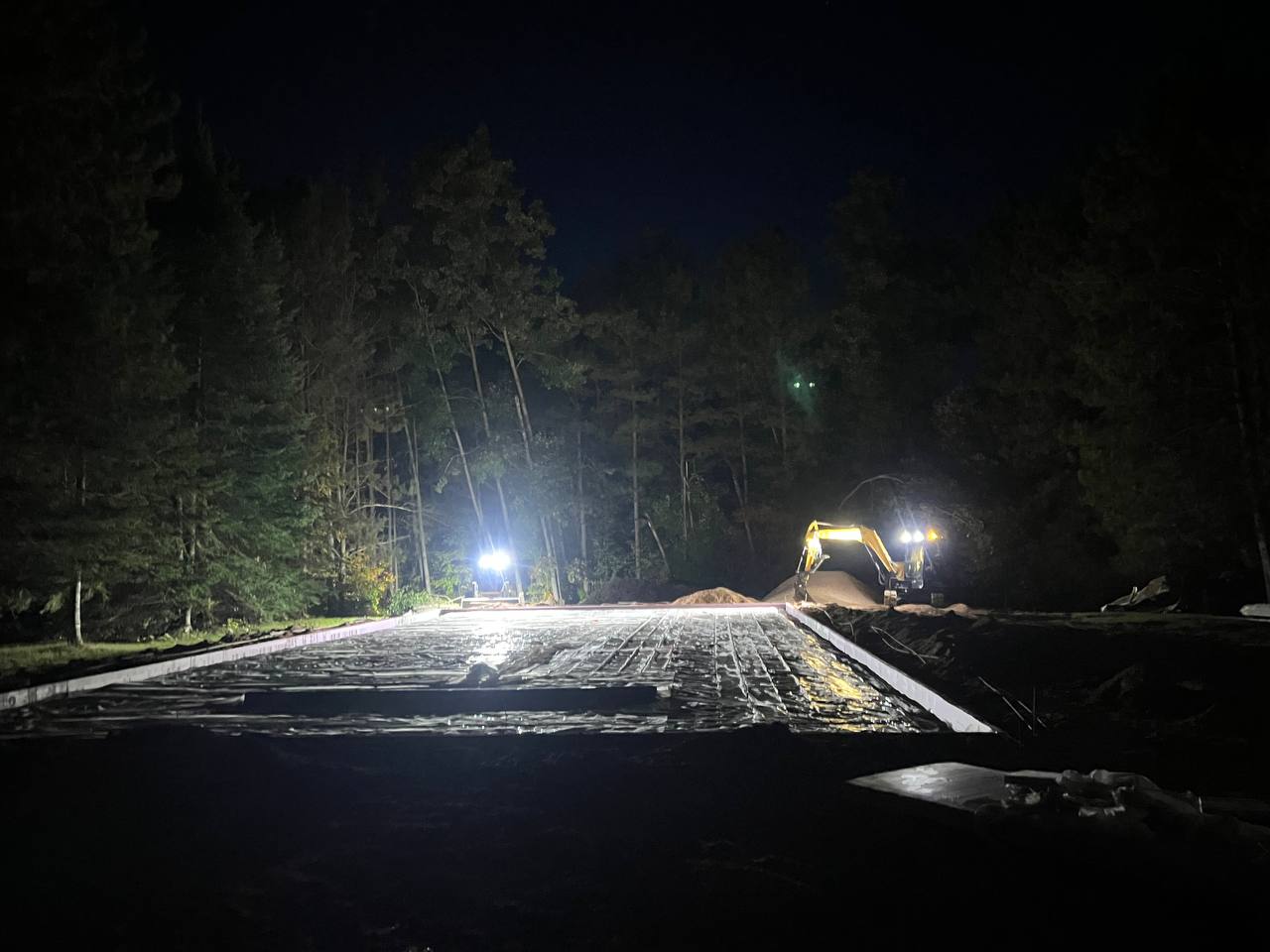
When the floodlights cut through the pitch-black tree line on a 40°F Northeast Wisconsin morning, most of the neighborhood is still sound asleep. But on a Quality Construction job site, the high-lumen lighting rigs are already humming, the concrete pump truck boom is fully extended overhead, and a warming fire burns in the staging area while our in-house crew preps the slab.
Pouring concrete in the dark isn’t a stunt, nor is it just about finishing early. When it comes to large post-frame shop floors, commercial slabs, or residential foundations in Green Bay, Appleton, and Shawano, a pre-dawn pour is a calculated engineering decision that can mean the difference between a lifetime slab and a structural failure.
The Science Behind Pre-Dawn Concrete Pours
Concrete curing is a chemical reaction (hydration), not merely a physical drying process. Managing the heat generated by this reaction is critical, especially during the volatile temperature swings of a Wisconsin autumn.
Controlling Thermal Shock and Moisture Retention
When concrete is poured under a hot midday sun, the top surface loses moisture too quickly. This rapid surface drying creates micro-cracks, surface crusting, and weak top layers while the core of the slab remains wet. By starting at 4 AM, the concrete achieves its initial set in cool, stable temperatures, allowing the moisture to equalize across the entire depth before the sun hits it.
Preventing “Cold Joints” on Continuous Slabs
For large concrete slab floors or agricultural buildings, ready-mix trucks must pour continuously. If a truck gets delayed in morning traffic along Highway 29 or I-41, the concrete already poured begins to harden before the next batch arrives. This creates a weak boundary known as a “cold joint.” Pouring before dawn ensures supply trucks move smoothly from batch plants to the job site without traffic delays.
What It Takes to Execute a High-Stakes Night Pour
Pulling off a flawless pour in the dark requires far more than turning on a few flashlights. It takes heavy equipment, strict site logistics, and an experienced team.
Commercial-Grade Lighting and Site Staging
Navigating a job site at night requires powerful floodlighting across the entire perimeter. Proper lighting ensures that sub-grade vapor barriers, edge forms, and rebar grids are completely inspected for debris or movement before the first yard of concrete drops.
Heavy Pumping and Vibration Equipment
When working under the lights, speed and placement accuracy are paramount. Utilizing boom pump trucks allows our team to place concrete precisely across massive footprints without disrupting underlying sub-grade insulation or radiant tubing. Meanwhile, mechanical vibrators eliminate trapped air pockets as the concrete is raked into place.
The In-House Crew Advantage
Night pours leave zero room for error or miscommunication. Because Quality Construction relies strictly on dedicated, in-house crews, never random third-party subcontractors, every worker knows their exact position the moment the pump starts. From holding the pump hose to power-screeding and hand-raking, seamless teamwork guarantees an even, dense pour from edge to edge.
Lock In Your Fall Concrete Project Before the Ground Freezes
Timing is everything in Northeast Wisconsin construction. Whether you are building a commercial warehouse, an agricultural storage shed in Cecil, or an in-floor radiant heated shop floor in Pulaski or Bonduel, our team has the heavy-duty equipment and dedication to execute your project flawlessly, day or night.
Don’t leave your foundation to chance. Contact Quality Construction today to request a free estimate on your upcoming concrete pour.